Born on March 7, 1875, in Ciboure, France; died on December 28, 1937, in Paris, France.
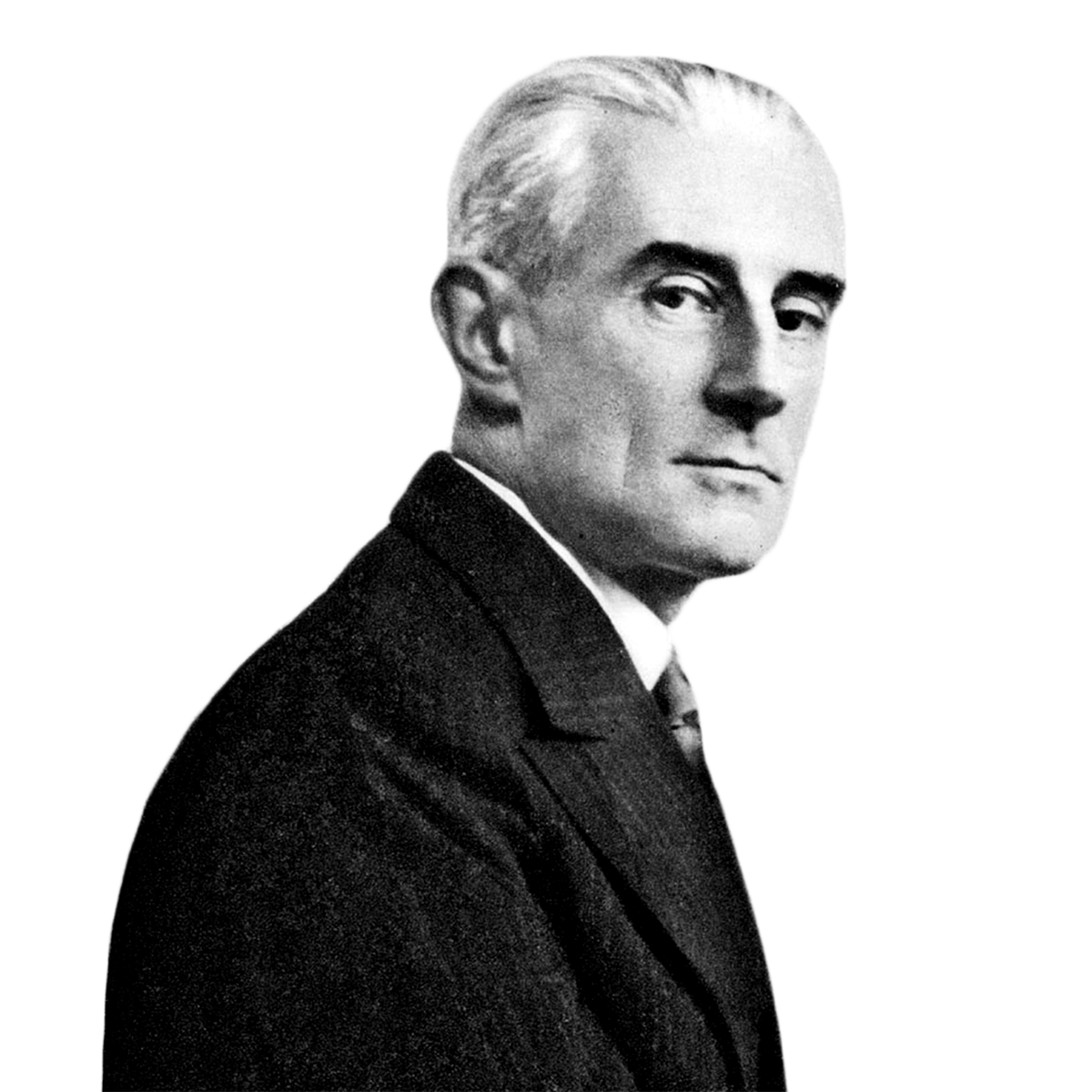
Piano Concerto in G major
Composed: 1929-31
Estimated length: 22 minutes
It wasn’t until late in his career that Maurice Ravel succeeded in the challenge of writing a concerto for his own instrument; as it happened, he produced two concertos, working on them side by side. The origins of the Piano Concerto in G major go back to sketches from 1914, and the work ranks among the French artist’s finest masterpieces.
Inspired by his 1928 tour of the United States, Ravel began composing in earnest the following year to showcase his own pianistic skills. But another commission soon intervened: the Piano Concerto for the Left Hand, written for Paul Wittgenstein, who had lost his right arm in the First World War after being shot by a Russian soldier and was now resuming his career by commissioning new repertoire for the left hand alone.
Once the Wittgenstein project was completed, Ravel returned to the Concerto in G, but as a result of his deteriorating health, he decided against playing the solo part himself and asked his friend Marguerite Long to give the premiere in Paris in 1932, with Ravel on the podium. The work was also featured on the program of the very last public concert he would conduct, in November 1933.
Ravel’s deep admiration for Mozart is especially evident in this music; so is his enchantment with American jazz, which he encountered during his four-month North American tour—especially via George Gershwin’s Concerto in F, which made a strong impression on him. As the more “classical” of his two piano concertos, the G major blends Mozart’s melodic poignancy, the sparkle of Saint-Saëns, and folklike simplicity, all touched by jazz-inflected rhythms and harmonies filtered through Ravel’s unmistakably refined style.
IN THE COMPOSER'S WORDS
The innocent wonder of childhood, recalling a kind of paradise for Ravel, also leaves its mark. The first sound, a little crack of a whip faintly evoking a circus spectacle, calls us to attention, after which Ravel gives the first theme—delightfully—to the piccolo, enhancing the atmosphere of childlike fantasy. Though scored for a chamber-sized orchestra, the movement offers a kaleidoscopic range of colors: woodwind chatter, harp flourishes, and sudden rhythmic detours.
Mozartian grace comes to the fore in the Adagio assai, a slow movement carrying the gentle trace of a nostalgic waltz. Without actually quoting Mozart, Ravel achieves a similar deceptive simplicity in the piano’s long opening solo and in the graceful pacing of the woodwinds’ entrances. Of this unforgettable melody, Ravel remarked: “How I worked over it bar by bar! It nearly killed me!” The English horn, in particular, becomes a haunting partner as the soloist weaves silken embroidery around its line.
The whip crack returns for the brief final movement, where Ravel resumes the funhouse spirit of the first movement—this time amped up into a glittering toccata with jazzy inflections from the E-flat clarinet, trombone slides, trumpet fanfares, and nimble percussion. The soloist navigates dizzying, acrobatic patterns until, with mischievous abruptness, Ravel repeats the four chords that set the movement spinning, punctuated by a final bang from the bass drum to draw the curtain.
In addition to solo piano, the score calls for piccolo, flute, oboe, English horn, 2 clarinets, E-flat clarinet, 2 bassoons, 2 horns, trumpet, trombone, timpani, percussion, harp, and strings.
− Thomas May is the Nashville Symphony's program annotator.
Featured on An American in Paris — March 12 to 14, 2026.
Nashville Symphony
Andrew Grams, conductor
Clayton Stephenson, piano
The Lawrence S. Levine Memorial Concert.



 Back