Born on November 24, 1960, in Oak Ridge, Tennessee; Currently resides in Nashville, Tennessee.
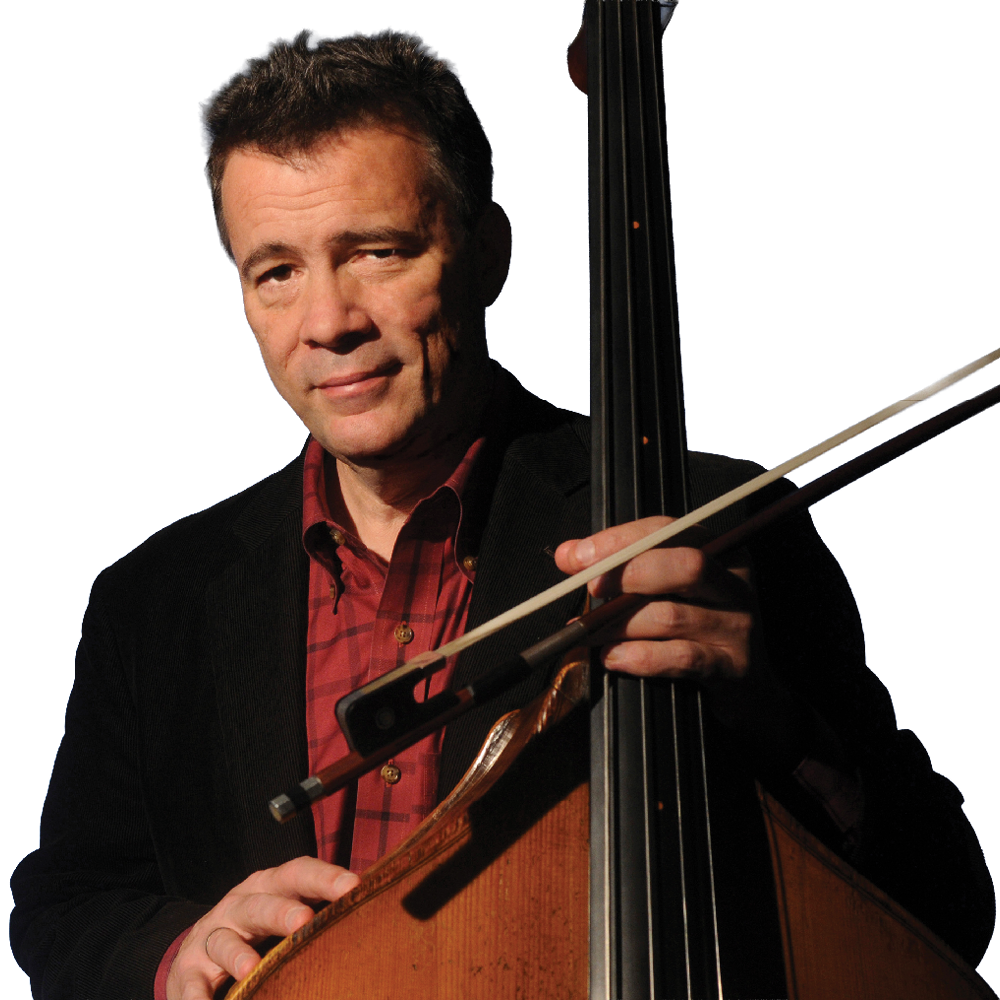
Concerto No. 2 for Double Bass in B
Composed: 2003; rev. 2020-21
Estimated length: 23 minutes
Nearly four decades ago, Edgar Meyer began his association with the Nashville Symphony as a young bassist under Kenneth Schermerhorn. The GRAMMY® Award-winning virtuoso has since become one of the most distinctive voices on his instrument, maintaining a longstanding relationship with the orchestra as a soloist, collaborator, and composer.
The origins of Concerto No. 2 for Double Bass in B reach back to 2003, when Edgar Meyer composed the work for his own use as soloist. From the outset, he was interested in finding a more responsive way to interact with the orchestra than the conventional concerto setup allows. As Meyer explained in a recent interview, interacting rhythmically with a large ensemble poses a different challenge than the close interplay he is accustomed to in smaller groups.
His solution was to introduce a second, highly distinctive presence alongside the soloist: a custom-built percussion instrument designed in collaboration with Nashville Symphony principal percussionist Sam Bacco, its creator and performer.
Constructed from PVC piping—a lightweight plastic tubing—and arranged in multiple rows like a keyboard, the instrument spans three octaves and allows access to 24 pitches per octave rather than the conventional 12. Mallets are used to produce a deliberately simple, relatively soft sound—an essential requirement, as Meyer wanted an instrument he could play alongside without being overpowered.
Dissatisfied with the original 2003 version—particularly its first two movements—Meyer returned to the Concerto in B in connection with a forthcoming recording of his three concertos and one concertino for double bass with Eric Jacobsen and The Knights, a New York-based chamber ensemble. Having concluded that the first two movements needed reworking, Meyer recomposed them entirely while retaining the overall design. The recording, which remains unreleased, is expected in the near future.
The concerto unfolds in three movements, with no pause between the second and third. Rather than associating it with a programmatic narrative, Meyer suggests that the music is not meant to tell listeners what to think, instead inviting them to form their own interpretations.
WHAT TO LISTEN FOR
The orchestra enters with a four-bar idea—a rising scale grounded in a unison B, which, whether ascending or descending, generates much of the first movement’s material. Immediately after, the solo bass and PVC pipe enter together, frequently operating in close alignment in extended passages.
They often play quarter tones together—notes that fall between the orchestra’s usual pitches, making their distinctive sound clearly audible. At times, these pitches can register as slightly “off” against the surrounding orchestral texture, creating a unique sound world. A tuned wooden log drum adds another layer to the work’s percussion palette.
Much of the material grows from scalar motion and tightly coiled chromatic figures unfolding in linear strands. The movement closes with a return to the close alignment of the two soloists, reinforcing their role as a coordinated presence.
The second movement opens with the bass in a more serene, lyrical light as it sings a sustained melodic line against gently pulsing pizzicato strings. But the calm is soon interrupted by bursts of rapid scalar motion. The movement alternates between music of striking agility and more dreamlike lyricism. Meyer exploits the full range of the instrument, including some sepulchral low notes far below the staff as well as high, tightly focused pitches at its upper extremity.
Without pause, the finale kicks off with the bass and PVC instrument in close coordination, laying out a continuous, fast-moving idea. The energy is thrillingly propulsive, driven by frequent shifts of meter and sharply articulated syncopation. The texture remains heavily active and forward-moving. The pitch B, which acts as an anchor across the concerto, serves as the final point of arrival.
In addition to solo double bass and PVC pipe, scored for 2 flutes, 2 oboes, 2 clarinets, 2 bassoons, 4 horns, timpani, tuned log drum, and strings.
− Thomas May is the Nashville Symphony's program annotator.




 Back