Born on December 16, 1770, in Bonn (now part of Germany); died on March 26, 1827, in Vienna
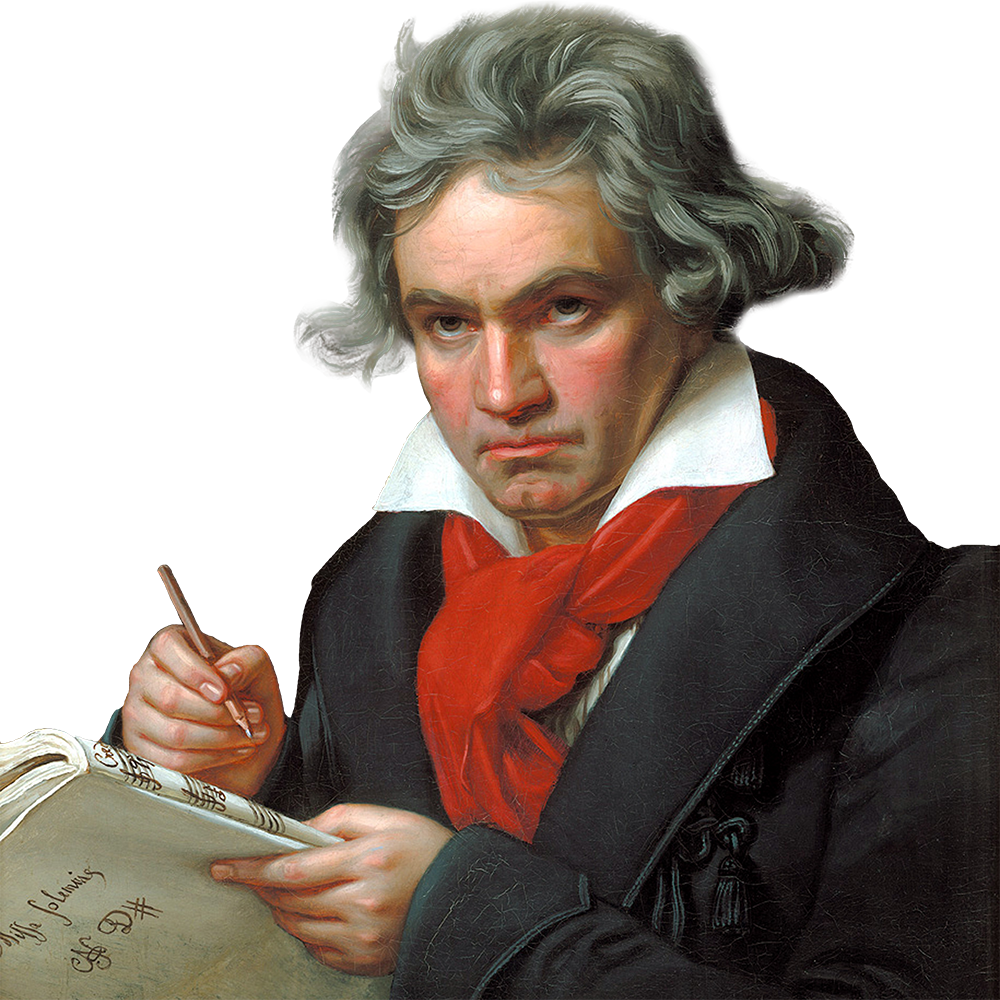
Symphony No. 3 in E-Flat major, Opus 55 ("Eroica")
Allegro con brio
Marcia funebre: Adagio assai
Scherzo: Allegro vivace
Finale: Allegro molto
Composed: 1802-04
Estimated length: 47 minutes
More than two centuries since its creation, Ludwig van Beethoven’s Eroica or “Heroic” Symphony No. 3 continues to inspire strong personal responses: Edgar Meyer has said that he currently considers the Eroica as his favorite Beethoven symphony. It marks a decisive turning point both in Beethoven’s personal life and in the history of the symphony itself.
The Eroica is closely bound up with a crisis the composer faced in his early thirties, when attempts to resolve the hearing problems that had troubled him for years proved futile. In 1802, following medical advice, Beethoven withdrew to the village of Heiligenstadt in hopes of recovery. The cure never came. Instead, he fell into despair, even contemplating suicide. That fall, he wrote the document now known as the Heiligenstadt Testament, describing his isolation and his fear of being misunderstood. Yet in the same text he affirmed a determination to continue living, driven by a sense of artistic purpose: he could not leave the world before fulfilling what he felt called upon him to create.
This resolve was linked to his search for what he called “a new path” in music. The Third Symphony is the first major work in which that ambition takes concrete form. Its instrumentation remains largely conventional for the Classical era—apart from the addition of a third horn—but the scope of the form is reimagined on a far larger scale.
The first movement has prompted a wide range of imagery—from a metaphoric battlefield to the energy of early industrial life—but its driving, epic force is unmistakable. Early on, the cellos introduce the main theme and come to rest on a striking note outside the home key, a moment that captures the music’s readiness to press forward into unfamiliar territory.
That sense of experience unfolds through expansion rather than compression. The music ranges across distant keys, ideas multiply, and the form itself grows beyond familiar bounds. Nowhere is this clearer than in the first movement’s enormous coda. Instead of providing a conventional tidying-up and brief close, Beethoven grows it to gigantic proportions, counterbalancing the journey that has gotten us there.
It is this scale and urgency that have often invited interpretations of the symphony in heroic terms. The work’s association with Napoleon Bonaparte reflects Beethoven’s engagement with such ideas. Initially admiring the French leader as a force for revolutionary change, Beethoven reacted with anger when he crowned himself Emperor, famously removing the dedication from the score. He ultimately published the work as a “Heroic Symphony,” describing it as composed “to celebrate the memory of a great man.”
WHAT TO LISTEN FOR
The first movement opens with two forceful chords that set the music in motion. Listen for the restless energy of the main theme and the way it keeps pressing forward, especially in the extended closing section, which pushes past any impression of a conventional ending.
The second movement is a funeral march, combining a sense of public ceremony with more inward expression. A contrasting passage briefly interrupts the darker tone with a brighter turn before the music returns with increased gravity, building to a powerful climax and a subdued close.
The Scherzo replaces the traditional minuet with something more energetic and unpredictable. Its rhythmic character creates a feeling of forward motion, while the middle section brings the horns to the foreground in prominent, echoing calls.
After a bold opening flourish, the finale begins with the bass line before the theme itself is introduced, forming the basis for a set of variations that grow into something far more expansive. From the chattering virtuosity of the flute to a nobly triumphant orchestral climax, the music even turns back in one striking passage toward the darker depths of the Funeral March. Through these transformations, Beethoven discloses the creative self as the true hero.
Scored for pairs of flutes, oboes, clarinets, and bassoons; 3 horns; 2 trumpets; timpani, and strings.
− Thomas May is the Nashville Symphony's program annotator.




 Back