Born on January 27, 1756 in Salzburg, Austrian Empire; Died on December 5, 1791 in Vienna, Austria
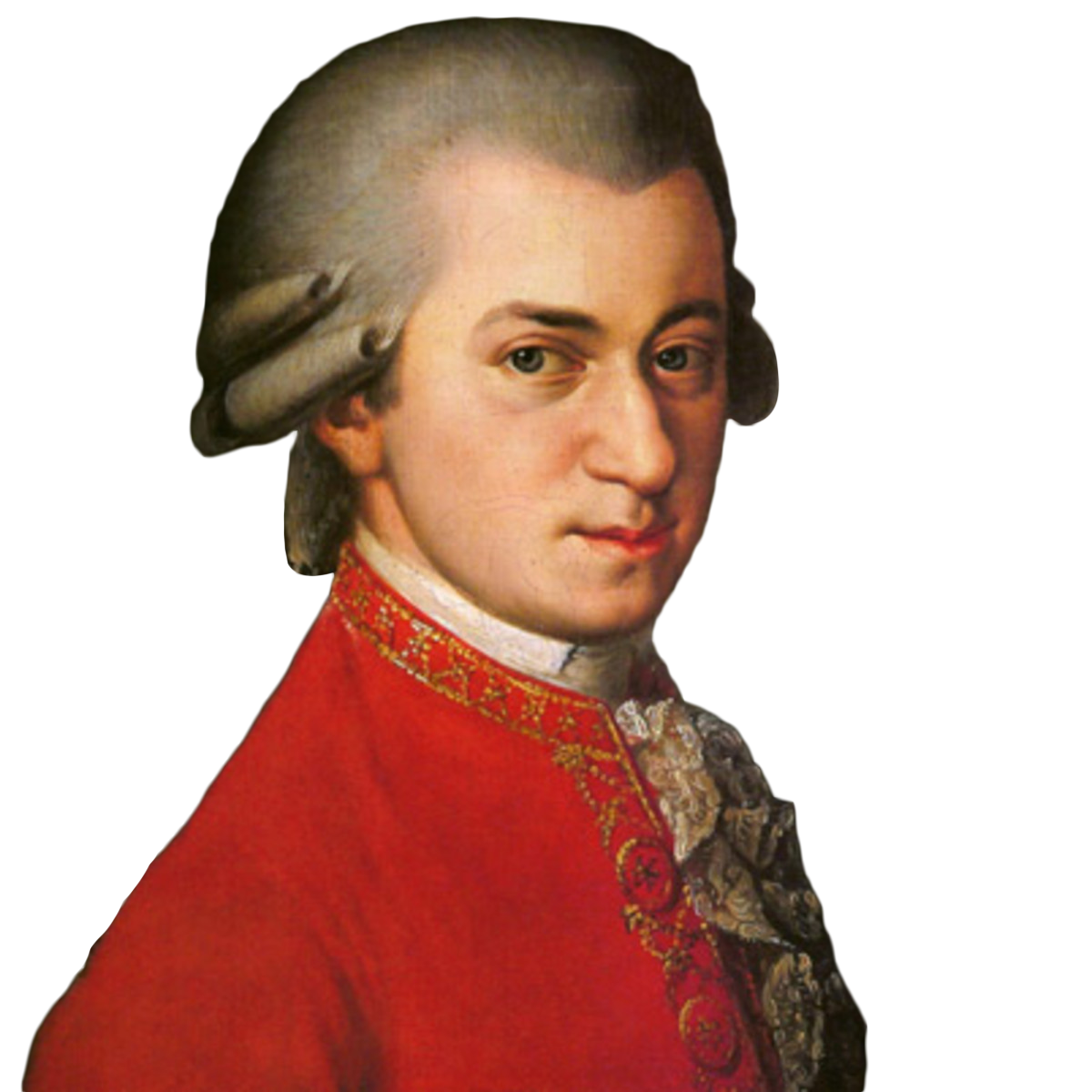
Symphony No. 41 in C major, K. 551 ("Jupiter")
Allegro vivace
Andante cantabile
Allegretto
Molto allegro
Composed: 1788
Estimated length: 35 minutes
The final symphony that Mozart completed—later nicknamed the “Jupiter”—grew out of an extraordinary burst of creativity in the summer of 1788. Mozart wrote his last three symphonies in roughly six weeks, a pace that would be impressive under any circumstances. That he achieved this during a period marked by financial strain, the death of an infant daughter, and worries over his wife Constanze’s health only deepens the sense of wonder. Yet from that difficult stretch emerged a trilogy of works, each a masterpiece with its own character and scope.
The last of these, the Symphony in C major, K. 551, eventually took on the “Jupiter” nickname—a posthumous addition but one that fits. The music carries a commanding, larger-than-life energy that suggests the immortal Olympian ruler evoked by the name.
Exactly why Mozart wrote these symphonies remains a mystery. No surviving commission explains their origin. Whatever the circumstances, the “Jupiter” is the work of a composer fully in command, thinking on a large scale and writing with supreme confidence.
That self-assured sweep even seems to anticipate the declarative energy Beethoven would bring to his Egmont Overture nearly two decades later. For all its status as a pinnacle of Classical style, the “Jupiter” reaches backward and forward at once. Mozart draws on the lively, interwoven style of the Baroque while also pointing toward the muscular musical language Beethoven would make his own.
WHAT TO LISTEN FOR
The “Jupiter” announces its expansive character right away: punctuated by drums and trumpets, the opening measures establish a bold attitude of C major. Soon after, Mozart lightens the mood with a more agile idea whose playful trills add a touch of theatrical wit, sharpening the contrast between the movement’s ceremonial and conversational sides.
In the Andante, muted strings create a soft halo around the woodwinds, giving the music its distinctive sense of suspended calm. The movement alternates gently between shadow and warmth. The Minuet begins with a slithery descending line that lends an unexpected hint of tension to its otherwise stately profile. When the trio arrives, the sound thins and softens, ushering in a more relaxed, pastoral warmth.
Then comes the finale, the part of the symphony that has earned the most admiration over the years. Mozart starts with an unassuming four-note motive in a simple pattern that listeners of the time would have instantly recognized from church “Amen” cadences. As the movement gathers force, Mozart draws on techniques he admired from the Baroque—especially the art of weaving independent musical lines together—while keeping everything grounded in the clarity of Classical style.
In the final minutes, Mozart stacks and interlocks his various musical strands so naturally that the effect feels both exhilarating and inevitable. This brilliant concluding section goes beyond a display of craftsmanship and shows Mozart at his most joyfully inventive.
Scored for flute; pairs of oboes, bassoons, horns, and trumpets; timpani; and strings.
− Thomas May is the Nashville Symphony's program annotator.
Featured on Mozart's Jupiter Symphony — January 9 & 10, 2026.
Nashville Symphony
Gemma New, conductor
Conrad Tao, piano




 Back