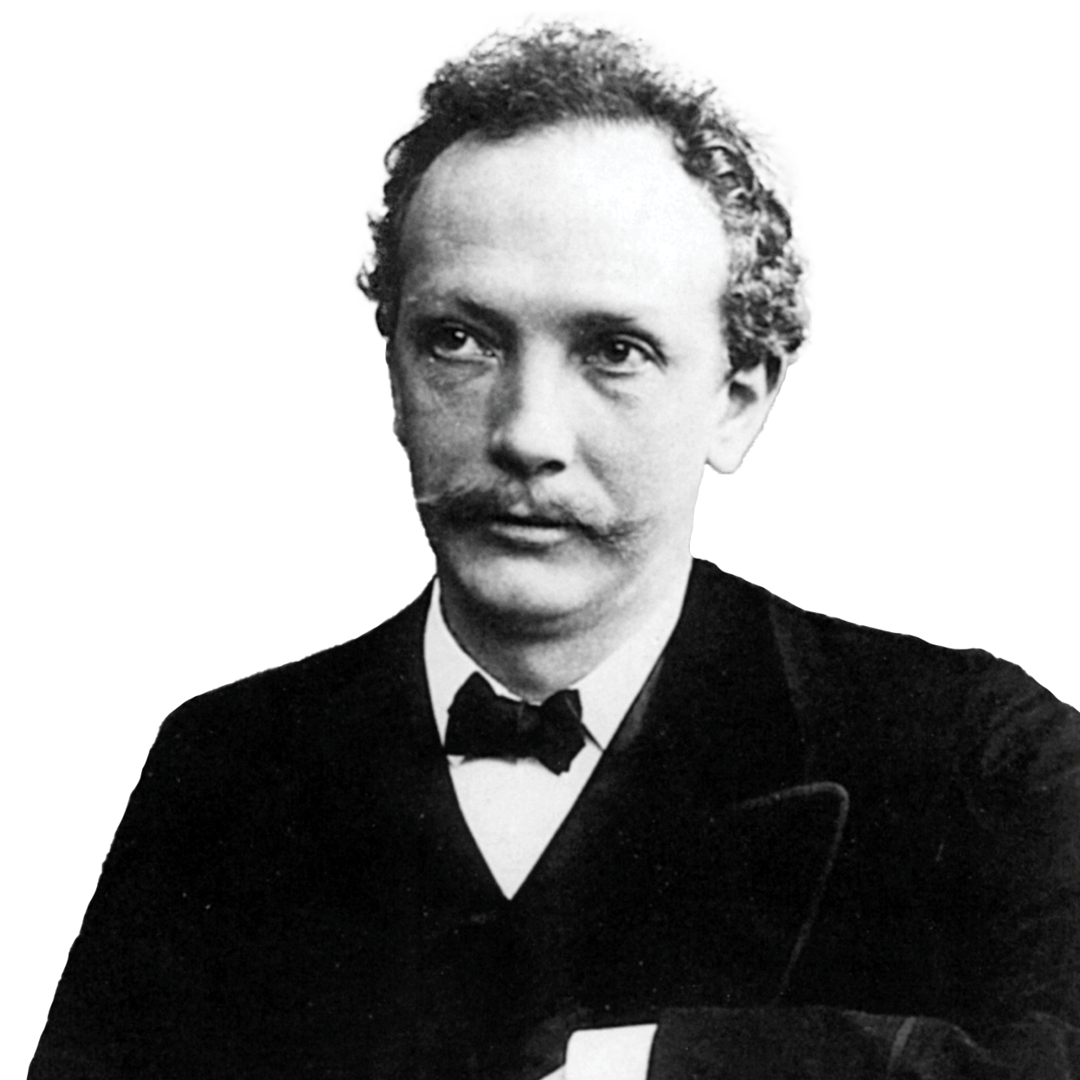
Born on June 11, 1864, in Munich, Germany; Died on September 8, 1949, in Garmisch-Partenkirchen, Germany.
Ein Heldenleben (“A Hero's Life”)
Composed: 1898
Estimated length: 46 minutes
Together with the music of Ginastera, Márquez, and Pacho Flores, Richard Strauss’s sweeping portrait of the artist as hero brings the program full circle—a journey from folk traditions and popular dances to the grand, self-reflective world of the late-Romantic symphony. When Strauss set out to write his orchestral essay on the idea of heroism, he chose the same “heroic” key of E-flat major that Beethoven used for his Eroica (“Heroic”) Symphony. Strauss was just 34 when he completed Ein Heldenleben (“A Hero’s Life”) in 1898—almost exactly the age Beethoven was when he finished the Eroica nearly a century earlier.
By the late 19th century, Strauss had revolutionized the tone poem, a form that tells a story through purely orchestral music. With earlier works such as Don Juan and Till Eulenspiegel’s Merry Pranks, he explored characters and narratives with unprecedented color and daring. Ein Heldenleben, however, went a step further. Instead of portraying mythic figures or literary heroes, Strauss turned the spotlight on the artist himself, creating an epic, tongue-in-cheek self-portrait. His original title was Held und Welt—“Hero and World.”
It’s tempting to hear Ein Heldenleben as simple autobiography—tempting as that might seem in our era of out-of-control narcissists—but Strauss’s ironic humor never lies around below the surface. By casting himself as the protagonist battling the world, he both celebrates and satirizes the late-Romantic ideal of the artist-hero. His contemporary Gustav Mahler was at the same time reinventing the symphony as a vehicle for spiritual autobiography. Biographer Michael Kennedy described Ein Heldenleben as “allegorical in nature, where the battlefield is one of the spirit, of inner conflicts.”
Strauss also nods to his musical lineage. Snippets of Wagner’s Tristan und Isolde appear in its pages, along with a striking quotation from Beethoven’s Eroica. Structurally, the piece is a single vast movement made up of six connected sections, unified by Strauss’s gift for thematic transformation.
WHAT TO LISTEN FOR
The hero strides forward immediately in the opening section, announced by a soaring, unaccompanied theme that spans several octaves. Its restless, upward-reaching character suggests ambition and striving. A sudden pause sets up the entrance of “The Hero’s Adversaries.” Strauss caricatures his real-life critics with squawking, chromatic woodwinds—more irritating than threatening at first. His mockery was so pointed that contemporary reviewers recognized themselves and took offense.
The longest section, “The Hero’s Companion,” introduces a solo violin representing Strauss’s wife, Pauline de Ahna. The concertmaster plays a dazzling part that functions like a miniature violin concerto. The music veers playfully through teasing fragments and shifting keys before swelling into an ardent love scene.
Offstage trumpets herald “The Hero at Battle.” Here Strauss unleashes the full power of the orchestra: clashing dissonances, pounding percussion, and surging brass convey a sense of chaos and conflict. This section shocked early listeners with its modernity, as the critics seem to transform into formidable enemies. Out of the tumult, the hero’s opening theme blazes forth in triumph.
Strauss then steps back in “The Hero’s Works of Peace.” Here he looks over his artistic achievements, weaving nearly three dozen quotations from his earlier works into a dazzling musical scrapbook—a reminder of the journey behind him.
The final section, “The Hero’s Flight from the World and the Fulfillment of his Life,” opens with a serene English horn solo, like a breath of pastoral calm. The adversaries briefly return, but their clamor is brushed aside by the return of the solo violin, now tender and consoling. In these final pages, the music turns inward. The hero retreats from public battles to a private world of love and reflection, ending not in hollow triumph but in something closer to elegy. Even so, Strauss adds a final flourish of proud, swelling chords—a last heroic gesture to close this extraordinary life in music.
Scored for piccolo, 3 flutes, 4 oboes (4th doubling English horn), 2 clarinets, E-flat clarinet, bass clarinet, 3 bassoons, contrabassoon, 8 horns, 2 piccolo trumpets, 3 trumpets, 3 trombones, 2 tubas, timpani, percussion, 2 harps and strings.
− Thomas May is the Nashville Symphony's program annotator.




 Back