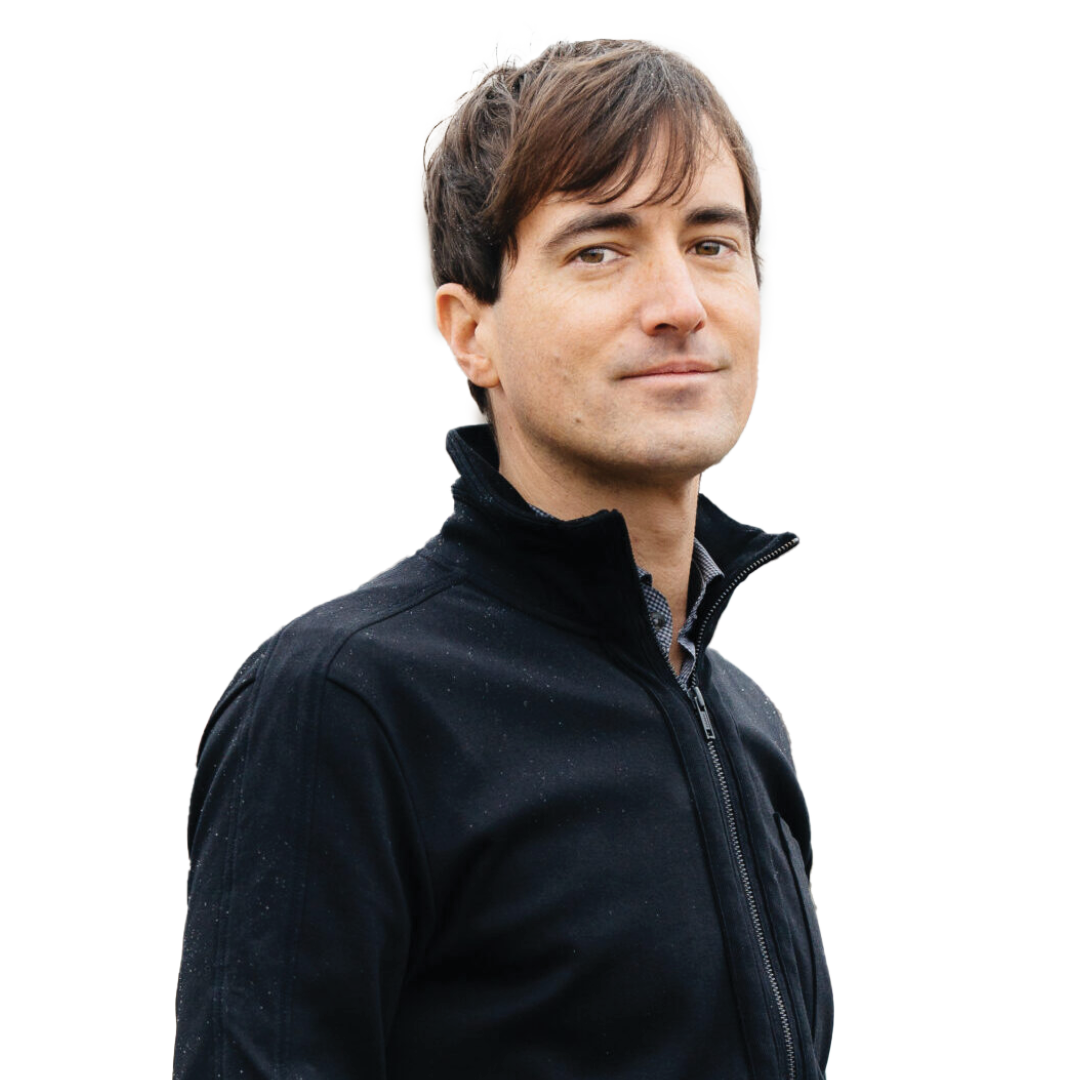
Born on January 23, 1977 in Philadelphia, Pennsylvania; He currently resides in Burlingame, California.
The Rhapsody of Steve Jobs
Composed: 2021
Estimated length: 12 minutes
When he died at the age of 56 in 2011, Steve Jobs had already assumed an almost mythical stature. With librettist Mark Campbell, Mason Bates transformed that legacy into The (R)evolution of Steve Jobs, premiered by Santa Fe Opera in 2017 and later taken up by companies nationwide. Rather than a conventional biography, the opera explores the contradictions of its subject—visionary brilliance alongside vulnerability and relationships.
Moving between the 2007 iPhone launch and his own memorial service, the opera traces Jobs’s arc from garage tinkerer and tech revolutionary to a man forced, through love and spiritual counsel, to confront his mortality—an outward revolution mirrored by an inward evolution.
Bates has remarked that what drew him to Jobs’s story was the role he played in transforming human communication. In the opera, Bates expands traditional orchestral resources with electronic elements that heighten its sense of velocity and technological sheen.
Against this charged, electro-acoustic environment, he sets contrasting musical identities: the buoyant energy associated with Steve Wozniak, Apple’s co-founder; the meditative aura surrounding his spiritual advisor Kōbun Chino Otogawa; and the lyrical grounding of Laurene, his wife and moral counterweight. These interacting sound worlds shape a portrait not of an icon alone, but of a man defined by relationships.
The Rhapsody of Steve Jobs, as Bates explains, “swirls together many key musical elements” from the opera into “a lively symphonic work [that] stays true to the kinetic surface of the opera, which uses an electro-acoustic sound world to conjure the excitement of the early Information Age.” Rather than assembling a conventional suite with themes presented in sequence, he opted for “a rhapsodic approach that interweaves them—a kind of free remix that required considerable new material.”
WHAT TO LISTEN FOR
“The anchoring theme is from the opening number ‘One Device,’ in which Steve Jobs mesmerizes the audience with the presentation of the first iPhone. This short motif is presented obsessively while a bustle of instruments accumulate around it, propelling us into the Overture of the opera. Between rondo-like reprises of the opening motif, we hear cameos of ‘Ma Bell’ (a swinging duet between Jobs and Steve Wozniak) and ‘Look Up, Look Out’ (Laurene Powell Jobs’s closing aria, which implores the audience to connect beyond devices). The coda brings us back to the opening product launch with a pulsing build of material that, like the cult-like following of Jobs himself, is both exuberant and frenetic.”
Scored for 3 flutes (3rd doubling piccolo), 2 oboes, 2 clarinets, 2 bassoons, 4 horns, 2 trumpets, 3 trombones, tuba, timpani, percussion, harp, and strings.
− Thomas May is the Nashville Symphony's program annotator.




 Back