Born on December 16, 1770, in Bonn (now part of Germany); died on March 26, 1827, in Vienna
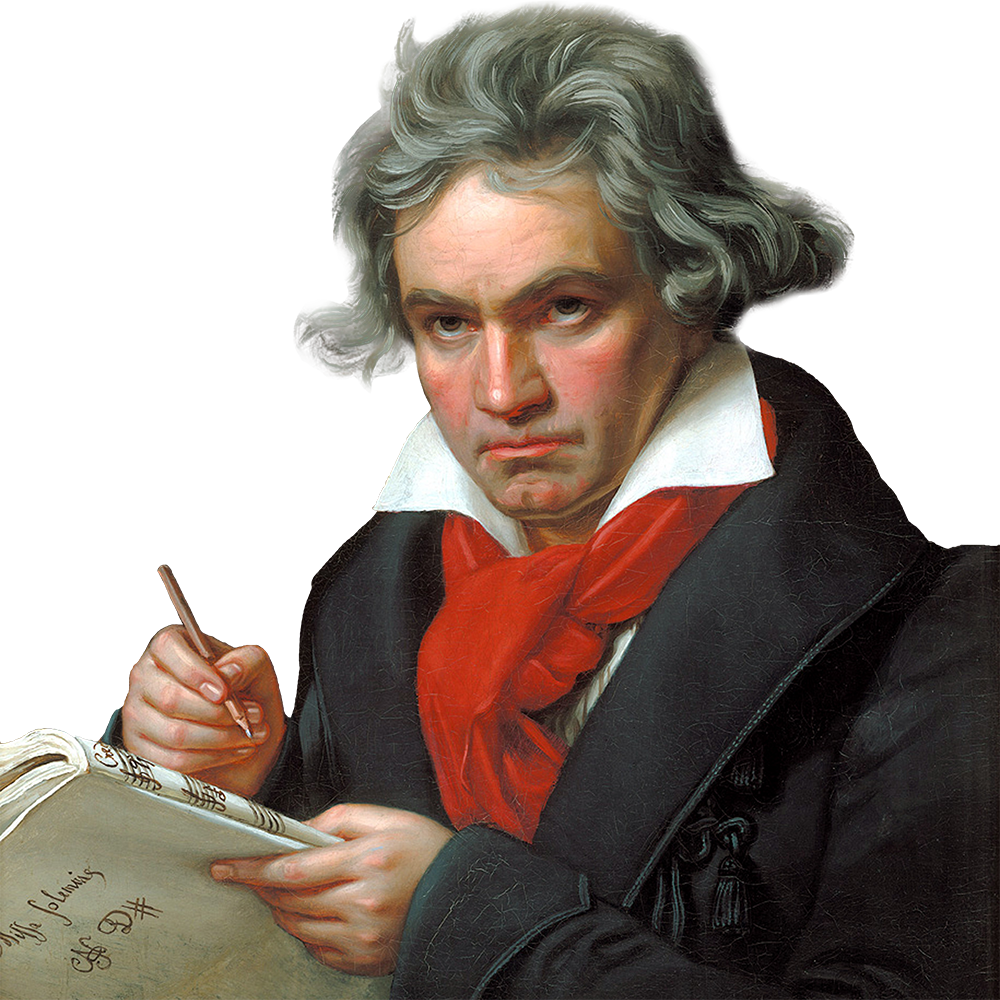
Symphony No. 7 in A major, Op. 92
Poco sostenuto - Vivace
Allegretto
Presto
Allegro con brio
Composed: 1811-12
Estimated length: 38 minutes
First performance: December 8, 1813, in Vienna, with the composer conducting.
Never has any art in the world created anything so radiant as these symphonies. … The effect upon the listener is of deliverance from all earthly guilt, precisely as the after-effect is the feeling of a forfeited paradise so that we return to the world of appearances.” In an essay marking Beethoven’s centennial in 1870, Wagner made these observations when discussing the Seventh and Eighth Symphonies.
Beethoven composed both works back-to-back, returning to the symphonic genre in 1811, more than three years after the famous marathon concert which unveiled the Fifth and Sixth Symphonies to the world (in 1808). Completed in 1812, the Seventh was premiered as part of a benefit concert for Austrian and allied veterans of the wars against Napoleon.
This concert marked one of the greatest public successes of Beethoven’s career. It included the premiere of a work that had an even greater impact on the audience: the (now nearly forgotten) novelty piece, Wellington’s Victory, which celebrated the routing of Napoleon’s brother Joseph and his forces in Spain. Its inspiration had been the “panharmonicon,” an extravagant mechanical instrument built to imitate the orchestra and created by the composer’s inventor friend Johann Nepomuk Mälzel.
The initial audience for the Seventh thus may have associated the outsize exuberance of this work with a sense of impending triumph over Napoleon’s once seemingly invincible power. Following years of disruptive warfare, a lasting peace was finally on the horizon. In one of music history’s more remarkable ironies, the Seventh dates from near the close of what is often termed Beethoven’s “heroic” period, which the Eroica Symphony had launched.
The Seventh is a masterpiece of so-called “absolute music”—in other words, a composition that is about the notes themselves rather than an attempt to depict something outside the world of music. Still, this score has inspired countless attempts to explain its power over listeners. Wagner himself characterized the Seventh Symphony as “the apotheosis of the dance: dance in its most exalted form, the most blissful of physical movement made manifest in sound.” Imagining Beethoven as a Prometheus re-creating humanity, he added: “Melody and harmony come together on the skeleton of rhythm to become flesh, a solid human form which takes up the steps of the dance before our very eyes …”
Other commentators have imagined ancient Bacchanalian rituals or peasant weddings as a hidden scenario. Beethoven’s acclaimed biographer Maynard Solomon wrote that the Seventh “powerfully symbolizes the act of transcendence, with its attendant joyous and liberating feelings…” He thought that this music somehow taps into an archetype of celebration similar to such festivals as Mardi Gras, in which restraint is temporarily cast aside to indulge in “a comic vision of life …”
WHAT TO LISTEN FOR
Beethoven constructs the Seventh from elemental building blocks, such as the scales that ascend in grandly sweeping gestures in the slow introduction. The length of this introduction is unprecedented, already suggesting the larger-than-life, epic scope of Beethoven’s vision. In a remarkable transition, he disrupts the sense of pulse and then proceeds to build it up again to push the music into the fastpaced first movement proper. The dynamic thrust of the rhythmic dimension is a special signature of the Seventh. In the final section of this movement, the insistently repeated rhythmic motif is juxtaposed with a slowly moving drone in the bass that generates an electrifying tension.
The Allegretto proved especially popular at the premiere and had to be encored. Beethoven uses a variation-by-accumulation principle, adding layers and additional voices to the orchestral texture as he repeats the main melody (itself built from an ultra-simple repetition of a long-short-short long-long rhythmic pattern). A beguiling melody offers contrast for the Allegretto, the Seventh’s only minor-key movement.
Another scale-based idea—this time descending— fuels the Scherzo, which lurches ahead with an unexpected shift of key. A contrasting section foregrounding a resolute trumpet call recalls the “ceremonial” character of the Allegretto. Introduced by hammer-blow chords, the finale sustains an almost terrifying state of exuberance. Once again, Beethoven plays strategies of motion and stasis off each other in the gloriously turbulent coda. Th effect of this music, according to Wagner, is nothing less than “the emancipation from all guilt.”
Scored for pairs of flutes, oboes, clarinets, bassoons, horns, and trumpets, timpani, and strings.
− Thomas May is the Nashville Symphony's program annotator.
Featured on Julia Wolfe's Flower Power and Beethoven's Seventh — January 24 to 26, 2025
Nashville Symphony
Giancarlo Guerrero, conductor
BANG ON A CAN ALL-STARS, ensemble




 Back