Born on December 16, 1770, in Bonn (now part of Germany); died on March 26, 1827, in Vienna
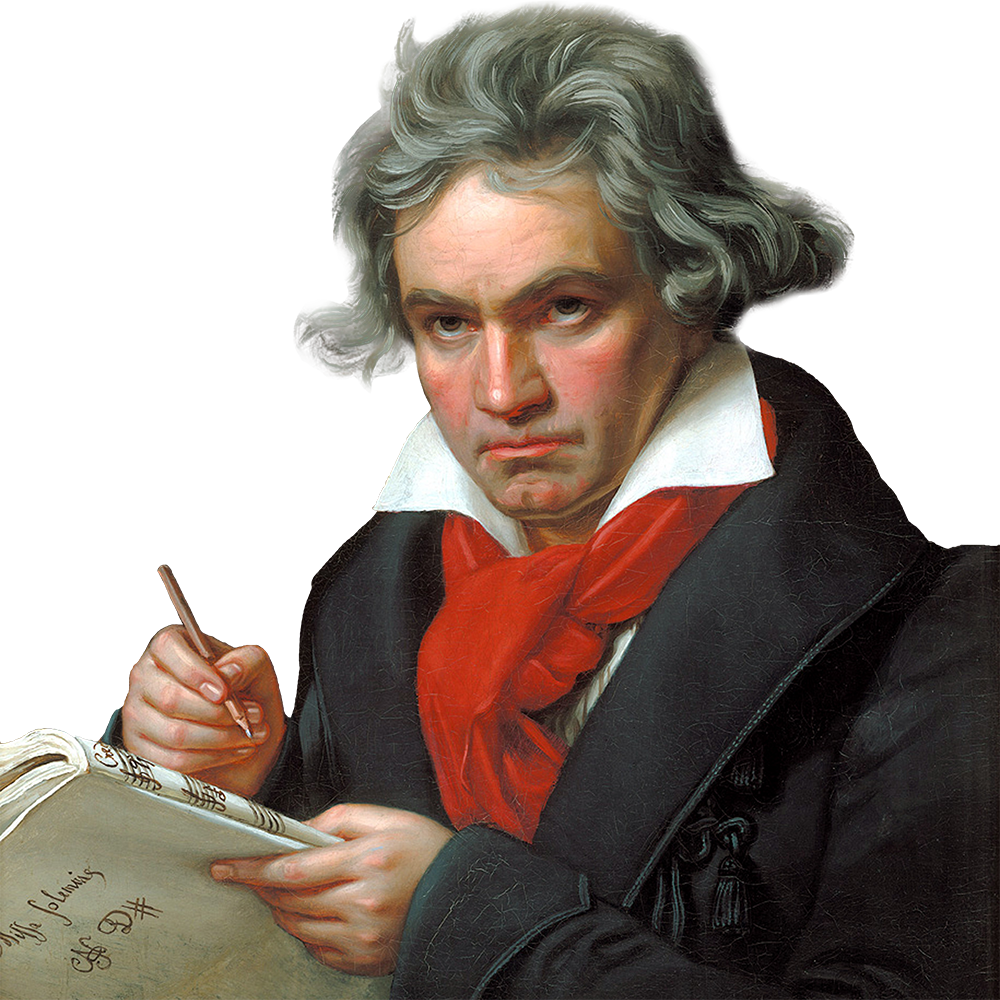
Symphony No. 5 in C minor, Op. 67
Allegro con brio
Andante con moto
Allegro
Allegro
Composed: 1804-08
Estimated length: 36 minutes
In his late twenties, Beethoven noticed troubling changes in his hearing, and by his early thirties he could no longer deny the devastating truth: he was going deaf. He tried every possible cure, but nothing slowed the decline. Eventually he had to accept that he would never again experience the full physical sensation of music.
Yet he refused to give in to despair. Beethoven clung fiercely to his artistic mission, determined to keep composing even as silence closed in. For later generations, especially in the Romantic era, his deafness became a symbol—proof that art could rise above the cruelties of fate. The Fifth Symphony, in particular, has been heard as an act of defiance, a refusal to surrender. It reforged the Classical style into something tougher, more personal, more dramatic: a rallying cry for the 19th century and beyond.
The Fifth Symphony premiered in late December 1808 in an unheated Viennese concert hall, part of a marathon program Beethoven organized himself. Its reputation as a testament to struggle and resilience would come later, as listeners began to grasp the power of this music. The opening gesture—four terse notes that slice through silence, immediately repeated—has become one of the most recognizable sounds in Western art.
That fragment has inspired endless speculation: some say it echoes a birdcall, others that it matches Homer’s poetic rhythm. Beethoven’s secretary Anton Schindler claimed the composer described it as “Fate knocking at the door” (though Schindler was notorious for inventing anecdotes). Whatever its origins, those four notes have come to embody conflict, defiance, and the possibility of victory.
WHAT TO LISTEN FOR
The four-note motto erupts at the very start—an explosion that sets off a chain reaction of ideas. From this fragment, Beethoven builds a confrontation that feels like a microcosm of the entire work. Yet it gives no assurance that triumph lies ahead—you need to hear the entire symphony to appreciate how ingeniously Beethoven shapes the journey.
The first movement develops the motto with fierce logic, ratcheting up tension at every turn. At one point, the storm halts for a plaintive oboe solo—a breath of vulnerability before the relentless drive resumes. In the coda, Beethoven stretches the form to an unprecedented scale, introducing new material only to hammer home the motto at the end.
The second movement offers contrast through variations: one broad and lyrical, the other compact and martial. Beethoven’s sharp contrasts of texture and mood here are as vital as the themes themselves.
The scherzo returns to C minor with a shadowy, whispered theme. Suddenly the strings burst into a manic dance in C major, brimming with excited anticipation. But the scherzo slips back in hushed tones, leading to one of the most suspenseful passages in orchestral music—a long, quiet build that finally breaks into the finale.
Here, at last, the symphony blazes into C major. What could possibly follow? Like sunlight breaking through clouds, C major has now arrived in full force … or has it? The ghostly scherzo reappears, as if to remind us that struggle is never fully vanquished. The return of the fanfare-like main theme is no less thrilling the second time around. It is as if Beethoven insists on reminding us that triumph is never a single moment, but something that must be earned again and again. Perhaps that is why, in the Fifth’s final minutes, he drives home this hard-won affirmation with such unrelenting force.
Scored for 2 flutes and piccolo, 2 oboes, 2 clarinets,
2 bassoons and contrabassoon, 2 horns, 2 trumpets, 3 trombones, timpani, and strings.
− Thomas May is the Nashville Symphony's program annotator.
Featured on Beethoven's Fifth Symphony: Elgar's Cello Concerto — October 2 & 3, 2025.
Nashville Symphony
Jonathan Taylor Rush, conductor
Zlatomir Fung, cello




 Back