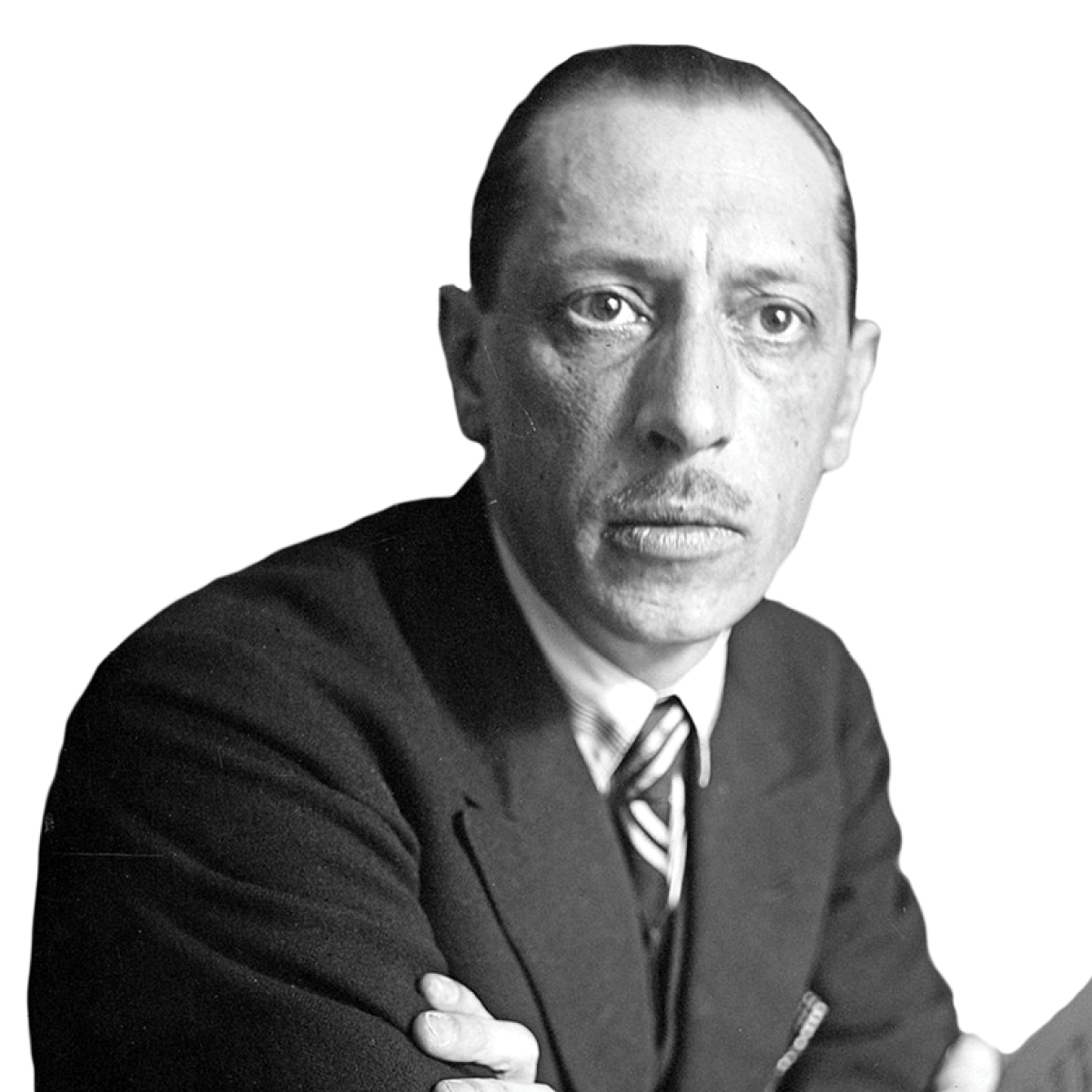
Born on June 17, 1882, in Oranienbaum, Russia; died on April 6, 1971, in New York City
The Firebird
Composed: 1909-10
Estimated length: 50 minutes
First performance: June 25, 1910, in Paris, as part of the Ballets Russes season (complete ballet).
First Nashville Symphony performance: March 29, 2007, with Asher Fisch conducting at Laura Turner Hall.
With The Firebird, Igor Stravinsky transformed a fairy tale known far and wide to Russian children into the smash success of the second season of the Ballets Russes, the company-in-exile that the impresario Sergei Diaghilev established in Paris. Diaghilev took an enormous risk in commissioning a 20-something unknown to compose the first entirely original score for his company, which up until then had presented previously existing works.
The Firebird catapulted Stravinsky overnight into an internationally respected composer. Diaghilev’s shows capitalized on the Parisian craze for all things Russian. Unlike his usual working method in later years—when he insisted on calling the shots—Stravinsky had to adapt to a ready-made scenario.
Based on a stylized version of Russian folklore that combined originally separate elements, The Firebird narrates a good-versus-evil struggle between the noble young protagonist, Prince Ivan, and an ogre-like figure known as the (supposedly) Immortal Kashchey or Kastchei (among the various transliterations of the Russian name), whose victims are liberated when Ivan brings about his downfall.
Ivan’s success, however, depends on the intervention of the spectacularly enchanting Firebird (with mythological links to the phoenix). The story unfolds in the magical realm where the villainous Kashchey keeps 13 princesses captive, having turned their would-be rescuers into stone.
Company member Michel Fokine, who also danced the role of the Prince, concocted the scenario with Alexandre Benois and created the choreography. Diaghilev gave Stravinsky access to a very large ensemble, which allowed him to exploit the colorful orchestral wizardry he had learned as a student of Nicolai Rimsky-Korsakov.
WHAT TO LISTEN FOR
From his mentor, Stravinsky learned an effective way to musically distinguish between the supernatural elements of the tale and the straightforward, folk-like simplicity that characterizes the mortals. Spooky conjurings low in the strings, at first barely audible, set the scene for Kashchey’s magical but illusory garden.
These are the grounds where Prince Ivan first encounters the Firebird, whose signature music of shimmering trills and dazzling colors is unmistakable. Ivan captures the creature but spares her life. In gratitude, she gives him a feather to summon her in time of need. (The role, traditionally gendered as female, was created by the great ballerina Tamara Karsavina, though Diaghilev’s star dancer Vaslav Nijinsky himself initially wanted the part.)
After the Prince captures and frees the Firebird, the creature pledges to aid him whenever he should call. The focus then shifts to the captive Princesses, who play with golden apples and perform a round dance. Enchanted, the Prince at once falls in love with one of them. The sounds of a magic carillon mark the appearance of Kashchey’s Guardian Monsters and then the ogre himself.
Ivan summons the Firebird, who casts a spell of her own. Whipped into motion by Stravinsky’s frenetic rhythms, Kashchey’s retinue is driven to exhaustion by the barbaric rhythms of the “Infernal Dance” (foreshadowing the violence of The Rite of Spring). A lullaby (“Berceuse”) lulls the hypnotized Kashchey to sleep. The Firebird shows Ivan how to vanquish his enemy by destroying a hidden egg that contains his soul (well before Harry Potter appeared on the scene). Kashchey’s world of illusion disintegrates into profound darkness.
In the brief second scene, a pristine folk tune played by solo horn announces the arrival of sunlight, setting in motion The Firebird’s ceremonial climax. Together with the Prince and his new bride, the rescued captives celebrate to increasingly animated variations on the folk melody. The way has been prepared for a utopian new dawn.
Scored for 2 piccolos (2nd doubling as 3rd flute), 2 flutes, 3 oboes, English horn, 3 clarinets (3rd doubling clarinet in D), bass clarinet, 3 bassoons (3rd doubling as 2nd contrabassoon), contrabassoon, 4 horns, 3 trumpets, 3 trombones, tuba, onstage brass, timpani, percussion, piano, celesta, 3 harps, and strings
− Thomas May is the Nashville Symphony's program annotator.
Featured on Stravinsky's The Firebird — October 17 to 19, 2024
Nashville Symphony
Giancarlo Guerrero, conductor
Gil Shaham, violin




 Back