Born on September 25, 1906, in Saint Petersburg, Russia; Died on August 9, 1975, in Moscow, Russia
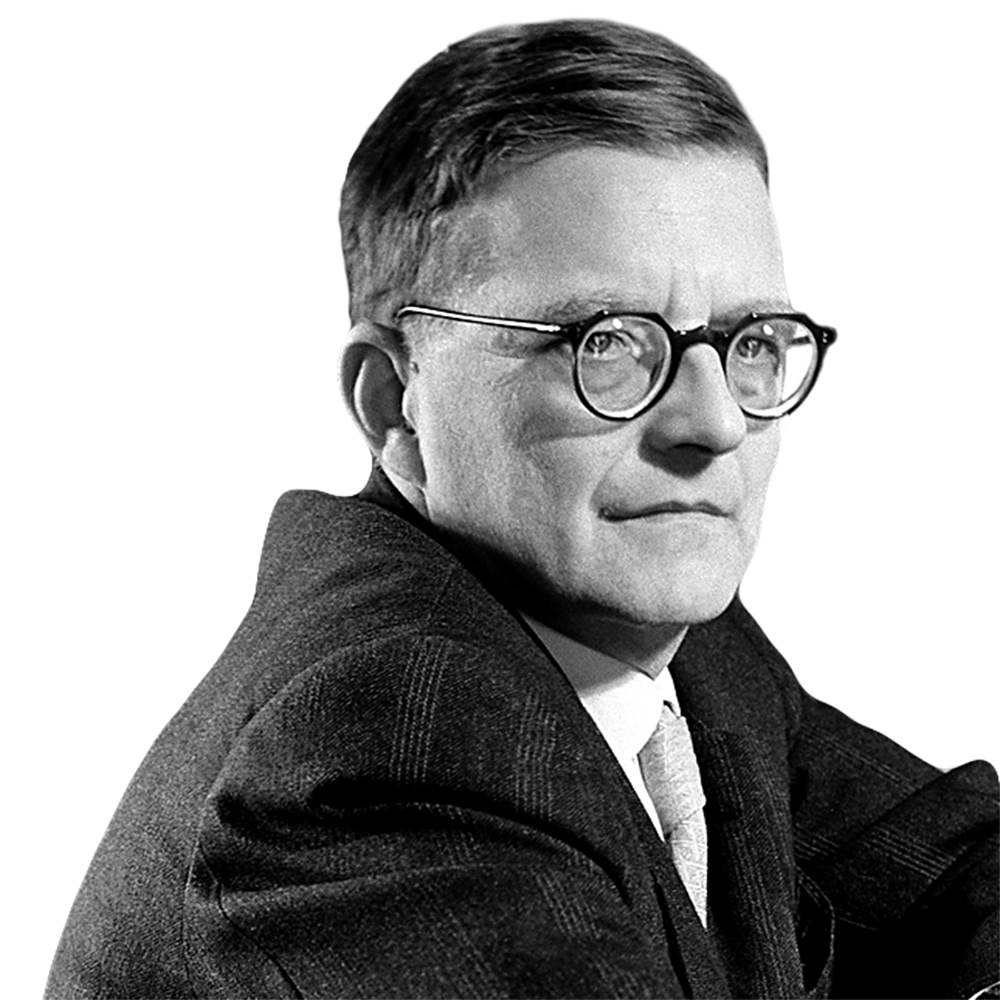
Symphony No. 1 in F minor, Opus 10
Composed: 1924-25
Estimated length: 33 minutes
First performance: 1926 in Leningrad
These performances are the Nashville Symphony premiere.
Our program brings together two Russian giants of successive generations: Rachmaninoff at the height of his powers, and the teenage Shostakovich just beginning to reveal his own distinctive voice. Shostakovich was only 18 when he completed the symphony that launched his career. Written in 1924 and 1925 as a graduation piece at the Leningrad Conservatory, the First Symphony emerged during a brief period of artistic experimentation following the 1917 Bolshevik Revolution. The abstract paintings of Kasimir Malevich, the avant-garde theater of Vsevolod Meyerhold, and the new possibilities of cinema all belonged to the cultural world in which the young composer came of age. Meyerhold was sufficiently impressed by the First Symphony to invite Shostakovich to collaborate with his theater company. The freedom that encouraged such experimentation would prove short-lived.
Shostakovich was already testing boundaries. His composition teacher objected to the “grotesque” character of the second movement, and Shostakovich himself briefly considered calling the work a “symphony-grotesque.” But its 1926 premiere was an overwhelming success and quickly established his reputation.
The symphony also reflects the practical life of a young musician who needed to earn money. Shostakovich worked as a pianist accompanying silent films, and the score often moves with something of cinema’s quick-cutting energy: abrupt changes of mood, sudden shifts of focus, and solo instruments suddenly stepping into the spotlight. The four-movement plan itself is conventional enough; what sounded new was the volatility within it, as marches, waltzes, introspection, and brash orchestral eruptions collide with startling speed. Such extreme contrasts would remain a hallmark of his music.
WHAT TO LISTEN FOR
A muted trumpet and bassoon open the symphony with a curious exchange before the clarinet steps forward. The pace soon quickens into a march-like theme, set against a waltz. The music keeps changing perspective, moving from exposed solos to brash outbursts from the full orchestra.
The second movement races ahead, with the piano—Shostakovich’s own instrument—adding a biting edge. After a contrasting episode led by the winds, the fast music returns only to collapse abruptly: the piano hammers out dissonant chords while the violins pulse almost under their breath.
The third movement turns inward. An oboe traces a mournful line, and a terse six-note tune begins to assume increasing importance. Near the end, a warmer string passage seems to offer consolation, only for the snare drum to cut across it and propel the music directly into the finale.
The finale ranges widely, from a solemn introduction to rushing scales and fanfares. A solo violin briefly opens a more lyrical space, delicately colored by bells and piano, before the faster music returns. Then comes one of the symphony’s most memorable moments: a timpani solo brings back the six-note sequence from the third movement, but turned upside down so that it now sounds almost like a question. Earlier ideas return as the orchestra drives toward a blazing conclusion—a triumph that still leaves a trace of unease.
Scored for piccolo, 2 flutes (2nd doubling piccolo), 2 oboes, 2 clarinets, 2 bassoons, 4 horns, 3 trumpets, 3 trombones, tuba, timpani, percussion, piano and strings
− Thomas May is the Nashville Symphony's program annotator.
Featured on Two Giants: Guerrero & Bronfman — November 19 to 21, 2026
Nashville Symphony
Giancarlo Guerrero, conductor
Yefim Bronfman, piano




 Back